
Introduction
A team can look incredibly busy and still fail to move the business forward.
I have seen this pattern repeatedly over the years: employees are online throughout the day, meetings fill the calendar, messages are answered almost immediately, and people work late into the evening. From the outside, everything looks active. Yet deadlines continue to slip, managers keep asking for updates, and important work gets pushed from one day to the next.
That is when I believe managers need to stop asking, “Are people working hard enough?” and start asking, “Are we actually measuring productivity, or are we measuring activity?”
The distinction matters. A systematic review of workplace productivity research considered 513 papers published since 2007 and found no consensus around a single KPI for office productivity. The researchers concluded that a multidimensional approach is more appropriate for measuring knowledge-worker productivity.
There is also evidence that performative activity is a real workplace issue. A Workhuman survey reported that 33% of employees said they fake productivity, while 48% of managers said faking productivity was a common issue on their teams.
The numbers are worth paying attention to, but I would not interpret them as proof that employees are simply trying to avoid work. In many cases, fake productivity is a symptom of something bigger: unclear expectations, excessive visibility pressure, poor processes, too many meetings or a workplace culture that rewards looking busy.
The first step, therefore, is understanding what fake productivity actually looks like.
What Is Fake Productivity at Work?
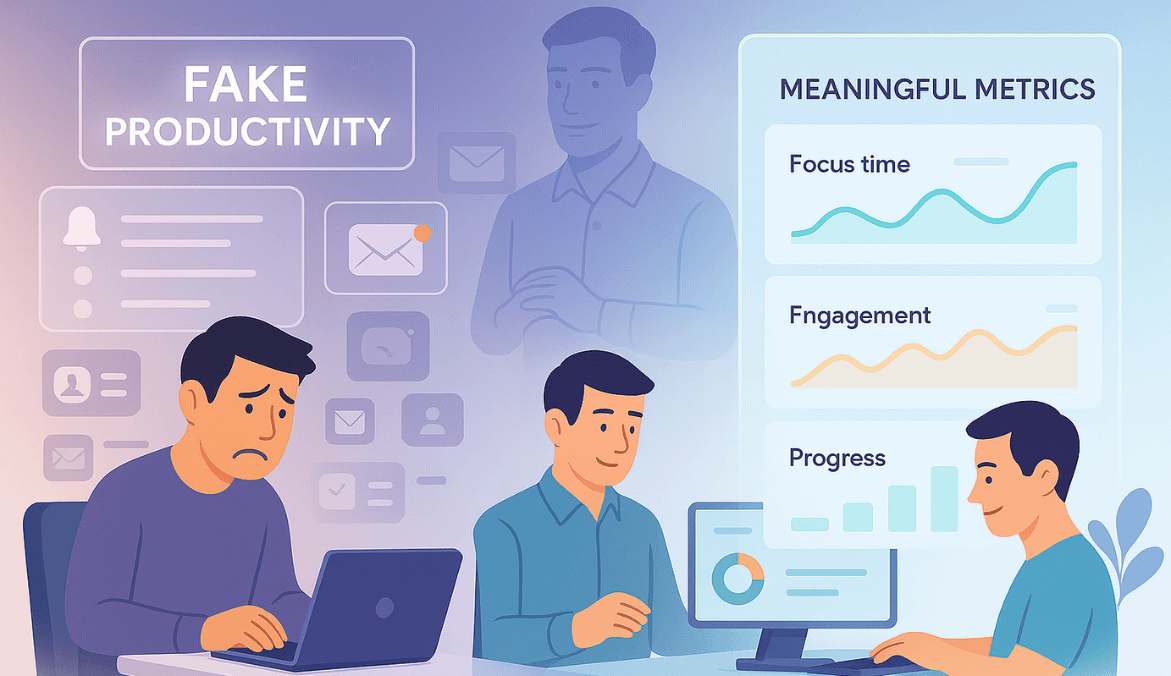
Fake productivity is the appearance of being productive without a corresponding level of meaningful progress or business output.
It can be deliberate, but it doesn’t always start that way.
Consider an employee who spends most of the day responding to messages, attending meetings, updating reports and staying available on communication platforms. They may genuinely be working. But if an important project remains unfinished because their time is being consumed by low-value activities, the organisation has a productivity problem.
This is often described as productivity theatre or fauxductivity.
SHRM describes productivity theatre as behaviour that creates the appearance of being busy without making a genuine contribution. Examples include unnecessary meetings, frequent but unproductive updates and working long hours simply to signal dedication.
The important distinction is:
Activity shows that something is happening. Productivity asks whether that activity is creating meaningful value.
That is why an employee being online for eight hours is not enough information to determine whether those eight hours were productive.
Why Busy Doesn't Always Mean Productive
This is one of the easiest mistakes for managers to make.
When work is visible, it is tempting to use visible behaviour as a shortcut for performance.
But:
- Being online for eight hours does not mean eight hours of productive work.
- Attending ten meetings does not mean ten productive contributions.
- Sending dozens of messages does not mean meaningful progress.
- Working late does not automatically mean high performance.
- High computer activity does not necessarily mean high-value output.
Knowledge work makes this particularly difficult because valuable work is not always easy to count.
A developer may spend several hours solving a difficult technical problem and produce a significant improvement. A manager may spend an hour resolving a team conflict that prevents weeks of future disruption. A sales professional may have one customer conversation that matters more than dozens of routine calls.
If you measure only activity, these contributions can be missed.
Research on workplace productivity measurement supports this broader view: there is no single KPI that works universally, and multiple dimensions are needed to understand knowledge-worker productivity.
In my experience, this is where many productivity initiatives go wrong. Organisations start by asking, “What can we measure?” when they should first ask, “What does good performance actually look like for this role?”
7 Signs of Fake Productivity Managers Should Watch
These signs should not be treated as proof that an employee is deliberately faking work.
They are signals worth investigating.
1. High Activity but Little Meaningful Output
One of the clearest warning signs is a persistent mismatch between activity and output.
An employee may appear active throughout the day, but important tasks remain incomplete.
Before reaching a conclusion, look at the context:
- Was the workload realistic?
- Were priorities clear?
- Were there dependencies?
- Was the employee dealing with frequent interruptions?
- Was too much administrative work consuming their time?
High activity combined with low output tells you that something needs attention. It doesn’t tell you exactly what the problem is.
That distinction is important.
2. Long Working Hours Without Corresponding Progress
Long hours are often interpreted as commitment.
Sometimes they are.
But if an employee consistently works beyond expected hours while important work continues to move slowly, it is worth investigating why.
The underlying issue could be:
- Excessive workload
- Poor prioritisation
- Inefficient processes
- Frequent interruptions
- Unclear responsibilities
- Too much low-value work
I have found that managers sometimes make the mistake of rewarding long hours without asking whether those additional hours are actually producing additional value.
The better question is: “What is making this work take longer than it should?”
3. Too Many Meetings, Too Little Progress
A calendar packed with meetings can make someone look extremely busy.
But meeting attendance is not the same as contribution.
For recurring meetings, ask:
- Does this person need to attend?
- Is there a clear purpose?
- Are decisions being made?
- Does the meeting remove a blocker?
- Could the same outcome be achieved another way?
If the answer is repeatedly no, the problem may be the organisation’s meeting culture rather than the employee.
SHRM similarly identifies unnecessary meetings and low-value updates as common examples of productivity theatre.
4. Constant Task and Application Switching
Digital work makes switching incredibly easy.
An employee can move from email to chat, from chat to a project tool, from there to a browser, then into a meeting and back to email—all within a short period.
From a dashboard, that can look like high activity.
From a productivity perspective, it may indicate fragmented work.
The right response isn’t to assume that every application switch is unproductive. Some roles naturally require frequent switching.
Instead, look for patterns.
If people repeatedly struggle to get uninterrupted time for important work, the organisation may have a workflow or communication problem.
5. High-Visibility Work Replaces Important Work
Some work is highly visible but low in value.
Frequent status updates, instant replies and constantly communicating availability can create an impression of strong performance.
Meanwhile, difficult work that requires concentration may receive less attention because it is less visible.
This is one reason performance should be connected to outcomes rather than simply measuring how much activity an employee generates.
6. Important Work Is Repeatedly Completed at the Last Minute
One late deliverable doesn’t indicate a productivity problem.
A recurring pattern is different.
If a team appears busy throughout a project but repeatedly rushes important work immediately before deadlines, investigate what is happening earlier.
Look for:
- Changing priorities
- Unclear ownership
- Approval delays
- Excessive meetings
- Dependencies
- Poor workload allocation
- Administrative work
Sometimes what looks like individual underperformance is actually a workflow problem.
7. Managers Cannot Explain Where Work Time Is Going
This may be the most important sign.
If managers know that employees worked a full day but cannot explain why important work didn’t progress, there is a visibility gap.
The answer isn’t to know every minute of an employee’s day.
The goal is to understand the relationship between:
Expected work → Time → Activity → Projects and tasks → Outcomes
Once those pieces can be viewed together, managers have better information for deciding where a problem actually exists.
How to Tell the Difference Between Activity and Productivity
A useful starting point is to change the question.
Instead of asking: “How active is this employee?”
Ask: “What meaningful work is this activity contributing to?”
Consider the difference:
- Visible Activity | Better Productivity Question
- Hours online | What meaningful work was completed?
- Number of messages | Did communication move work forward?
- Meetings attended | What decisions or outcomes resulted?
- Applications opened | Were they relevant to the role?
- Long working hours | Did additional time create additional value?
- Task activity | Are important tasks progressing?
- Computer activity | Is meaningful output improving?
This doesn’t mean activity data has no value.
It means activity needs context.
That is perhaps the most important principle in this entire discussion.
How to Measure Employee Productivity More Effectively
If you want to identify fake productivity, start by defining what genuine productivity means for the organisation.
Start With Expected Outcomes
Every role should have a clear understanding of what successful work looks like.
The measures will differ.
A sales role may focus on qualified opportunities, customer relationships and revenue.
A support role may focus on resolution quality, response times and customer outcomes.
A development team may focus on completed work, quality, reliability and delivery against milestones.
There is no universal productivity formula.
Compare Time With Workload
Time becomes much more useful when considered alongside workload.
Someone working long hours may be overloaded.
Someone completing work consistently ahead of schedule may have additional capacity.
Someone spending unusually long on a task may be dealing with complexity, dependencies or unclear requirements.
The same number of working hours can therefore tell very different stories depending on context.
Look at Attendance and Working Patterns
Attendance can help organisations understand whether expected schedules are being followed.
But attendance isn’t productivity.
It is simply another piece of context.
A person can have excellent attendance and still struggle because of inefficient processes or excessive workload. Another person may work differently from traditional office hours and still deliver excellent results.
The metric should answer a business question—not become the business judgment.
Understand Activity Patterns
Activity information can help identify recurring patterns in how working time is distributed.
Depending on the role and organisation, this can include:
- Active time
- Idle periods
- Away periods
- Working schedules
- Application usage
- Website usage
- Project activity
Again, the key is pattern rather than snapshot.
One unusual day is rarely enough to tell you anything meaningful.
Connect Time With Projects and Tasks
This is where workplace visibility becomes more useful.
Suppose a team spends 200 hours on a project.
The useful questions are not simply: “Were those 200 hours productive?”
Instead:
- Which tasks consumed the time?
- What was completed?
- Which tasks took longer than expected?
- Where did work slow down?
- Was the workload distributed appropriately?
- Were there recurring bottlenecks?
Those answers are much more actionable.
5 Productivity Metrics Business Leaders Should Watch
There isn’t one perfect productivity metric. But several measures can provide useful context when considered together.
1. Productive time vs. total working time
This can show how working time is distributed.
2. Project and task time
This shows where effort is being allocated across actual work.
3. Attendance and schedule adherence
This provides context around expected working patterns.
4. Workload and utilisation
This can help identify teams or individuals who may be overloaded or underutilised.
5. Application and website activity
This can reveal recurring patterns in how digital work time is being spent.
But don’t turn these into a single employee score.
The research doesn’t support the idea that one universal KPI can accurately capture knowledge-worker productivity.
The goal is to build a more complete picture, not create a more sophisticated way of judging people.
How Fake Productivity Can Affect Business Performance
Why should business leaders care about fake productivity?
Because the cost is not simply a few hours of wasted time.
It can affect the way the entire organisation operates.
Missed deadlines
Teams can remain busy while critical work continues to slip.
Poor resource allocation
Managers may believe everyone is fully utilised when some people are overloaded and others have available capacity.
Higher operational costs
More hours spent working do not automatically translate into more valuable output.
Burnout
Employees may feel pressure to demonstrate constant activity rather than focus on meaningful work.
Poor management decisions
When visible activity becomes the primary performance signal, organisations can end up rewarding the wrong behaviours.
SHRM notes that productivity theatre can undermine efficiency and contribute to stress and burnout, particularly when workplaces value appearances over meaningful outcomes.
The bigger issue, therefore, isn’t simply that someone might be pretending to work.
It is that the organisation may be measuring the wrong thing.
How to Identify Fake Productivity Without Micromanaging
This is where many companies take the wrong turn.
They notice a productivity problem and respond by increasing surveillance.
That can create another problem.
If employees believe they are being judged primarily on visible activity, they have even more incentive to demonstrate visible activity.
SHRM specifically points to excessive oversight and micromanagement as factors that can encourage performative behaviour, while recommending clearer goals and an outcome-focused approach.
A better approach is straightforward.
Step 1: Identify a recurring pattern
Don’t act on one unusual day.
Step 2: Compare it with workload
Understand what the employee or team was expected to accomplish.
Step 3: Add context
Look for blockers, meetings, process issues, dependencies or workload problems.
Step 4: Have a conversation
Use the information to ask questions—not make accusations.
Step 5: Address the underlying problem
The issue may be prioritisation, workload, training, communication or process design.
Step 6: Measure again
See whether the situation improves.
This changes the purpose of productivity data.
Instead of asking: “How can we catch someone being unproductive?”
you are asking: “What is preventing this person or team from doing their best work?”
That’s a much healthier management conversation.
From Employee Monitoring to Workplace Visibility
There is an important difference between monitoring employees and understanding work patterns.
Monitoring asks: “What is this employee doing?”
Workplace visibility asks: “What patterns are affecting how this team works?”
The second question is much more useful for business leaders.
You may discover that a team spends too much time in meetings.
You may find that certain employees consistently carry more workload.
You may identify recurring idle periods caused by dependencies.
You may find that project work is regularly interrupted by other responsibilities.
These aren’t simply employee issues.
They are operational insights.
And operational insights can lead to better decisions about processes, workloads, staffing and priorities.
How Mera Work Can Help Businesses Understand Productivity Patterns
Mera Work provides workplace visibility across areas such as work time, attendance, activity, application and website usage, projects, tasks and productivity reporting.
The purpose is not to label someone “productive” or “unproductive” based on one number.
It is to give managers more context around how work is happening—where time is being spent, how work patterns vary and where potential operational inefficiencies may exist.
That context can support better conversations around workload, productivity and resource allocation.
A Practical Framework: Observe → Compare → Contextualise → Act → Measure
If you’re concerned about fake productivity in your organisation, don’t make the process complicated.
Use five steps.
Observe
Look for recurring patterns in activity and work progress.
Compare
Compare those patterns with workload, responsibilities, projects and expected outcomes.
Contextualise
Understand what is causing the pattern before reaching a conclusion.
Act
Address the underlying issue—whether that is workload, process, priorities, communication or resource allocation.
Measure
Review the same indicators again and see whether the situation has improved.
The strength of this approach is that it keeps productivity data in its proper place.
Data should help managers ask better questions. It shouldn’t make the decision for them.
Conclusion
Fake productivity becomes a business problem when organisations start rewarding the appearance of work instead of the value of work.
The solution isn’t necessarily more monitoring.
It is better visibility, better measurement and better management.
Look at activity, but put it in context. Consider workload, projects, tasks, time and outcomes together. Pay attention to recurring patterns instead of isolated events. And when something doesn’t add up, investigate the process before assuming the person is the problem.
After 12+ years of seeing how teams and organisations approach productivity, one lesson stands out: the busiest person in the room isn’t necessarily the person creating the most value.
If your organisation is measuring activity every day, do you really know how much of that activity is creating meaningful business value?
FAQs
Fake productivity is when workplace activity creates the appearance of productivity without producing a corresponding level of meaningful progress or business value.
Common signs include high activity with low output, excessive meetings, long working hours without corresponding progress, frequent task switching, repeated last-minute work and a lack of clarity around where working time is going.
Managers should look for recurring patterns and compare activity with workload, projects, tasks and outcomes. A single metric should never be treated as proof of an employee's productivity.
No. Fake productivity can involve individual behaviour, but it can also be created by unclear expectations, excessive meetings, poor processes, workload issues or a workplace culture that rewards visible activity.
Start with the outcomes expected from each role. Then use supporting measures such as project and task progress, working time, attendance, utilisation and relevant activity patterns to provide context.
Focus on recurring patterns rather than individual actions. Use data to identify potential issues, then discuss the context with employees and managers before deciding what action is needed.
Activity describes what someone is doing during working time. Productivity is about how effectively that effort contributes to meaningful work and business outcomes.
Productivity software can highlight patterns in time, activity, attendance, workload and work allocation. It should not automatically decide whether an employee is productive or unproductive. That requires role-specific context and managerial judgment.