Introduction
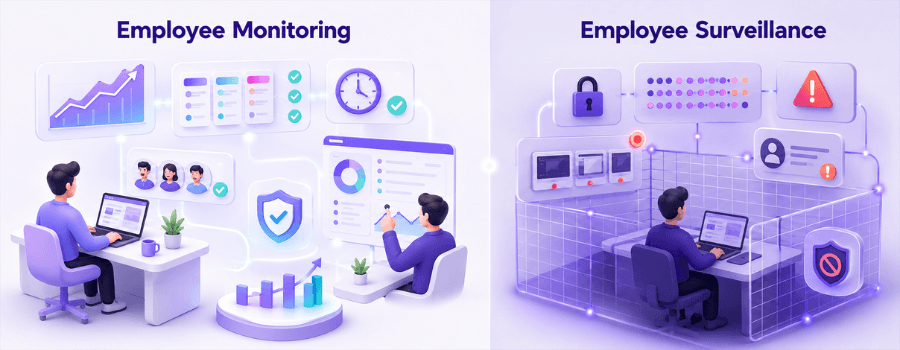
Employee monitoring and employee surveillance are often used as similar terms, but they are not the same. Both involve tracking workplace activity, but the purpose, approach, transparency, and impact on employees can be very different.
For modern businesses, this difference matters.
A company may need visibility into attendance, work hours, productivity trends, application usage, website activity, and project progress. This is where employee monitoring can help. When done ethically, it gives managers the data they need to improve workflows, support accountability, and manage remote or hybrid teams more effectively.
Employee surveillance, on the other hand, is often associated with excessive tracking, hidden observation, and control-focused supervision. If handled poorly, it can affect employee trust, workplace culture, and privacy.
This article explains the key differences between employee monitoring and employee surveillance, why the distinction matters, and how businesses can use workforce visibility tools responsibly.
Quick Comparison: Employee Monitoring vs Employee Surveillance
| Factor |
Employee Monitoring |
Employee Surveillance |
| Main Purpose |
Improve productivity, accountability, and work visibility |
Observe or control employee behavior |
| Transparency |
Usually communicated through clear policies |
May be unclear, excessive, or hidden |
| Focus |
Work-related activity and productivity insights |
Continuous observation or personal behavior tracking |
| Employee Trust |
Can support trust when used ethically |
Can reduce trust if used excessively |
| Data Usage |
Used for reporting, planning, and workflow improvement |
May be used for strict control or disciplinary review |
| Best Use Case |
Remote team management, time tracking, productivity analysis |
Security-sensitive environments, only when justified |
| Ideal Approach |
Transparent, policy-driven, work-focused |
Limited, justified, and carefully controlled |
What Is Employee Monitoring?
Employee monitoring is the process of tracking work-related activities to understand how employees use their working hours, tools, and systems. It helps businesses gain visibility into productivity, attendance, task progress, and workflow patterns.
Modern employee monitoring software can track data such as:
- Login and logout time
- Active and idle time
- Attendance and shift activity
- Application usage
- Website usage
- Screenshots or screen activity, where required
- Project and task time
- Productivity trends
- Employee activity reports
The goal of employee monitoring is not to watch every action. The real purpose is to help businesses understand how work is happening and where improvements are needed.
For example, if a team is spending too much time switching between tools, facing repeated idle time, or missing project timelines, employee monitoring data can help managers identify the issue and take corrective action.
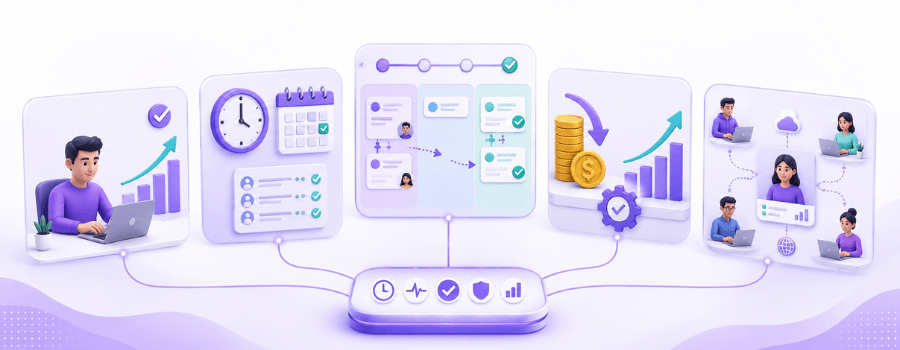
When implemented properly, employee monitoring supports:
- Better productivity visibility
- Stronger accountability
- Improved time management
- Better remote and hybrid team management
- Data-backed workforce decisions
- More accurate attendance and payroll records
Ethical employee monitoring focuses on work activity, not personal behavior.
What Is Employee Surveillance?
Employee surveillance refers to close observation of employees, often with a stronger focus on control, compliance, or behavior tracking. It may involve continuous screen watching, camera monitoring, detailed keystroke tracking, location tracking, or other forms of intensive observation.
In some industries, limited surveillance may be necessary for security, safety, or compliance reasons. For example, organizations handling highly sensitive data may need stronger access controls or activity logs to reduce risk.
However, surveillance becomes problematic when it is excessive, hidden, or not clearly connected to a legitimate business purpose.
Employee surveillance may create concerns such as:
- Reduced workplace trust
- Employee discomfort
- Privacy concerns
- Fear-based work culture
- Lower morale
- Resistance to monitoring tools
- Legal or compliance risks
The key issue is not whether businesses collect work-related data. The issue is how much data is collected, why it is collected, how transparent the process is, and how the data is used.
Key Differences Between Employee Monitoring and Employee Surveillance
Employee monitoring and employee surveillance differ in purpose, scope, transparency, and impact on workplace culture.
1. Purpose
Employee monitoring is usually designed to improve productivity, accountability, workforce visibility, and operational efficiency. It helps managers understand work patterns and support better performance.
Employee surveillance is more control-focused. It is often used to observe employee behavior closely or detect violations, risks, or suspicious activity.
2. Transparency
Ethical employee monitoring is communicated clearly to employees. Businesses explain what is being tracked, why it is being tracked, and how the data will be used.
Employee surveillance may feel less transparent, especially if employees are not fully aware of the monitoring methods or the extent of data collection.
3. Scope of Tracking
Employee monitoring generally focuses on work-related activity such as time tracking, attendance, app usage, website usage, project time, and productivity reports.
Employee surveillance may go deeper into continuous observation, screen watching, keystroke logging, camera footage, location tracking, or detailed behavior monitoring.
4. Impact on Trust
When implemented responsibly, employee monitoring can improve trust because expectations become clearer and decisions are based on data instead of assumptions.
Excessive surveillance can damage trust because employees may feel they are being watched constantly or judged without context.
5. Data Usage
Employee monitoring data is usually used for productivity improvement, workload planning, attendance review, project management, and operational decision-making.
Surveillance data may be used more for investigation, enforcement, disciplinary action, or security control.
6. Employee Experience
Employee monitoring can support employees by giving them clarity around expectations, work hours, task progress, and performance trends.
Employee surveillance can create pressure if employees feel every action is being watched without a clear reason.
Why the Difference Matters for Businesses
Understanding the difference between employee monitoring and employee surveillance is important because it directly affects workplace culture.
Businesses need visibility, especially when managing remote teams, hybrid teams, field employees, support teams, BPOs, IT teams, and distributed operations. Without visibility, managers may depend on manual follow-ups, assumptions, or incomplete reports.
But visibility should not come at the cost of trust.
A balanced employee monitoring approach helps businesses:
- Improve productivity without micromanagement
- Track work hours accurately
- Support remote and hybrid team management
- Identify workflow bottlenecks
- Improve project planning
- Strengthen accountability
- Maintain transparency with employees
On the other hand, excessive surveillance can lead to:
- Employee resistance
- Lower morale
- Privacy concerns
- Reduced engagement
- Higher stress
- Workplace distrust
This is why modern organizations should focus on ethical employee monitoring instead of unnecessary surveillance.
Ethical Employee Monitoring: Best Practices
Ethical employee monitoring is transparent, work-focused, and purpose-driven. It gives businesses the visibility they need while respecting employee privacy and workplace trust.
Here are some best practices businesses should follow:
1. Be Transparent With Employees
Employees should know what is being monitored, why it is being monitored, and how the data will be used. Clear communication reduces confusion and builds trust.
2. Create a Clear Monitoring Policy
A written employee monitoring policy should explain the scope of monitoring, tracked data, access permissions, data usage, and privacy safeguards.
3. Track Only Work-Related Activity
Monitoring should focus on work hours, work tools, project activity, productivity trends, and business systems. Personal activity should not be tracked unnecessarily.
4. Use Role-Based Access
Only authorized managers, HR users, or business leaders should have access to employee monitoring reports. Access should be limited based on role and responsibility.
5. Avoid Excessive Tracking
Businesses should avoid collecting more data than needed. Monitoring should support productivity and accountability, not create pressure or fear.
6. Review Data in Context
Employee monitoring data should be interpreted carefully. Low activity, idle time, or app usage patterns may have valid reasons. Managers should use data as a starting point for better conversations, not as the only basis for judgment.
7. Protect Employee Data
Monitoring data should be stored securely and handled responsibly. Businesses should follow applicable privacy, labor, and data protection requirements.
Examples of Employee Monitoring Software
Employee monitoring software can help businesses track work activity, improve productivity visibility, and manage distributed teams more effectively. Different tools offer different levels of time tracking, reporting, screen visibility, activity monitoring, and workforce analytics.
Here are some common types of solutions businesses may evaluate:
Mera Work
Mera Work helps businesses improve work visibility through time tracking, attendance monitoring, active and idle time tracking, app and website usage tracking, screenshot monitoring, live screen monitoring, project and task time tracking, and workforce analytics.
It is designed to help managers understand how work happens across teams without depending on constant follow-ups or assumptions. Mera Work supports a more structured and transparent approach to employee monitoring.
Time Tracking and Productivity Tools
Some tools focus mainly on time tracking, timesheets, productivity reports, and project-based work logs. These are useful for teams that need better visibility into working hours, client billing, or task-level time usage.
Workforce Analytics Platforms
Some platforms focus more on productivity analytics, work trends, employee activity insights, and operational reporting. These are useful for businesses that want to understand patterns across teams and departments.
Remote Team Monitoring Tools
Remote team monitoring tools help managers track attendance, activity, screenshots, app usage, and productivity trends for distributed employees.
When choosing a tool, businesses should compare features, privacy controls, reporting depth, ease of use, scalability, and support quality.
Employee Monitoring vs Employee Surveillance: Which Approach Is Better?
For most modern businesses, employee monitoring is the better and more sustainable approach.
Employee monitoring gives companies the visibility they need to manage productivity, attendance, workloads, and remote teams. It supports better decisions without creating a culture of fear.
Employee surveillance should be used only when there is a clear business, legal, security, or compliance requirement. Even then, it should be limited, transparent, and properly governed.
The best approach is to use monitoring as a workplace visibility tool, not as a control mechanism.
A responsible employee monitoring strategy should answer three important questions:
- What data do we need to improve work visibility?
- How can we collect this data transparently?
- How can we use this data to support both business performance and employee trust?
When businesses answer these questions clearly, employee monitoring becomes a productivity and accountability tool instead of a surveillance concern.
How Mera Work Supports Ethical Employee Monitoring
Mera Work is built to help businesses improve workforce visibility without encouraging micromanagement.
With Mera Work, organizations can track important work-related data such as time, attendance, active hours, idle time, app usage, website usage, screenshots, live screen activity, project time, and productivity trends.
The platform helps managers understand:
- Who is working
- When work is happening
- Which tools are being used
- Where time is being spent
- Which tasks or projects need attention
- Where workflow gaps may exist
- How productivity trends are changing over time
Mera Work supports structured monitoring by helping businesses focus on relevant work activity instead of unnecessary personal tracking.
It can help organizations:
- Improve remote and hybrid team visibility
- Reduce dependency on manual follow-ups
- Strengthen accountability
- Identify productivity gaps
- Manage project and task time better
- Support transparent workforce reporting
- Make better operational decisions
The goal is simple: give businesses the clarity they need while supporting a more balanced, transparent, and responsible approach to employee monitoring.
Common Mistakes to Avoid
Businesses should avoid these mistakes when implementing employee monitoring software:
1. Monitoring Without Informing Employees
Hidden monitoring can damage trust and create serious workplace concerns. Employees should be informed before monitoring begins.
2. Tracking Too Much Data
Collecting unnecessary data can make monitoring feel invasive. Businesses should track only what is relevant to work performance, security, and operations.
3. Using Data Only for Punishment
Monitoring data should not be used only to question employees. It should also help improve processes, balance workloads, and support better performance.
4. Ignoring Privacy Controls
Without role-based access and clear data permissions, sensitive employee activity data may be viewed by the wrong people.
5. Not Reviewing Data in Context
Numbers do not always tell the complete story. Managers should combine monitoring insights with communication, team context, and business priorities.
Final Thoughts
Employee monitoring and employee surveillance are not the same.
Employee monitoring is about improving workforce visibility, productivity, accountability, and operational clarity. Employee surveillance is more focused on close observation and control.
For most businesses, the right approach is ethical employee monitoring. It provides useful work insights while respecting employee privacy, maintaining transparency, and supporting a healthier work culture.
As remote and hybrid work continue to grow, businesses need better visibility into how work happens. But visibility should be balanced with trust.
With the right employee monitoring software and clear policies, organizations can improve productivity without micromanagement and build a more accountable, transparent, and efficient workplace.
FAQ